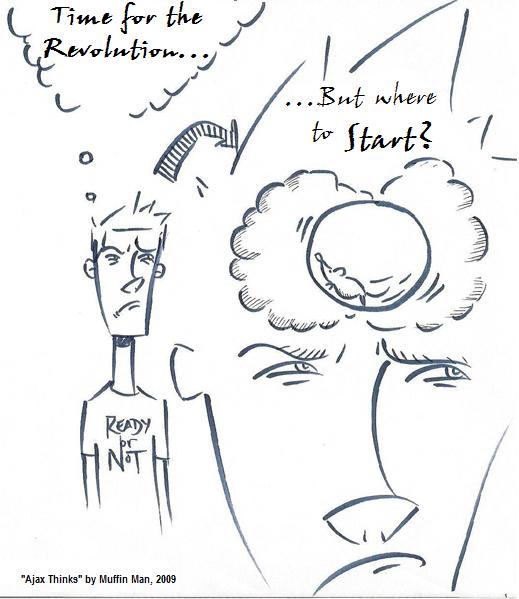
Ajax Thinks

Ajax Thinks
by Muffin Man

Tuesday, July 6, 2010

The Dickens

A few days back, maybe a week or more, I was responding to a text message shortly after I had gotten into bed. As I flipped open my phone to reveal the keyboard the dark room was lit up by the small screen. The muscles adjusting my pupils strained to adjust for the new light. How's that for setting the mood? Well, I opened the phone and accidentally pressed the voice button and my phone started talking to me. It scared the dickens out of me. I remember thinking that, and then wondering what the phrase means. I thought that perhaps it was good if the dickens were scared out of me, I don't know that I need them hanging around. I finally got around to looking it up. A question and answer posting from World Wide Words suggests that "the dickens" is an old euphemism for the devil (http://www.worldwidewords.org/qa/qa-dic3.htm). Older than Shakespeare, in fact, who used it in one of his plays. If this is an accurate history of the phrase, then I am going to stay with my initial thought, I don't want the dickens in me because now I know that it is the devil. The question now becomes why would we say something scared the dickens out of us when we get really scared? Or better yet, why is the devil in us in the first place? With this new understanding I will not use the phrase anymore. I will make a suggestion for an appropriate substitution: you've scared me like the dickens. I think I will make this part of my revolution, knowing the meaning of the words and phrases I use. As long as there are unsubstantiated Internet resources to help me I think I will be just fine.

Monday, July 5, 2010

Quote of the Day

Here is another offering from the quote of the day widget. Is it called a widget? That's what they call the song player add-on, so I'll assume the quote add-on is a widget as well. Here's the quote:
Be less curious about people and more curious about ideas. - Marie Curie
I'm not sure what is being said here. Is she suggesting we spend more time with ideas than with people? If so, I don't agree with that. People are more important than ideas. If she is saying we should be less suspicious about people and more suspicious about ideas then I am on board. Since she is a scientist and I know absolutely nothing more specific about her, I'm going to suppose she was more interested in ideas than people. (If anyone knows if this isn't the case, please let me know. ) I think we should be curious about people, as the definition of the word is "eager to learn or to know" (http://dictionary.reference.com/browse/curious, but don't go there because it takes a long time to load and is wacky, I hope this commentary doesn't make you too curious). We ought to want to learn about and know people more than ideas. I wish I did. I don't think I do all the time, but I think I'd like to. It is good to be curious about ideas, but I would place more caution on this one than on people. Let's be curious about people and suspicious about ideas. Take that Marie Curie! The quote of the day widget is nice, but there are a lot of quoted ideas that I don't agree with. Which I think is good. Opposing points of view help you to determine what you really think and feel. Maybe not you, but me, I just said you because that's how I say things.
I'm watching the Mets play the Reds right now. It is one of those tense games. The Mets were on the down side of a missed call by the umpires which led to some bad news. Directly it led to one run, which was followed by five more. There is no way to know whether or not those runs would have been scored had the play in question been made correctly, but psychologically you know it takes a toll on the players. Happily the Mets came back to score five runs in the bottom half of that inning. It is currently in the bottom of the 8th and the score is 8-6, Reds. I hope the Mets come back to win it. To which I will say "Take that Marie Curie!" once again. She's probably a Reds fan.

[note: I do not have a vendetta against Marie Curie. I respect and appreciate her work in the advancing of physics and chemistry.]

Sunday, July 4, 2010

What is so Great About Change? And Another Thought

Everyone is always talking about change. They say it is good. I say change is neither good nor bad, in and of itself. People talk about how old things are out of date and the progression of time requires change. Why? Is there anything wrong with time tested and proven? I think people just get caught up in assessing the "now" and finding it isn't all that they dream it could be. They then think that change is the only answer. But what does change mean? And how can you guarantee it is good? Change isn't one thing or another; it is a description of what is becoming something else. Changes in temperature and air pressure result in rain, which is good, but they also sometimes result in tornadoes, which are bad. Change isn't concrete, it is abstract. When we cry out for change and hang slogans around our necks, let us be a bit more selective and specific. Don't seek change, seek progression. Don't change who you are, become who you want to be. Abstraction has its place, but so does concrete. I've heard a saying attributed to George Washington (I don't have a source and I don't particularly feel like looking for one right now), the saying is this: Deeds. Not words. We can sing the praises of change, which doesn't exist, or we do the actions and live the characteristics (virtues) that will allow us to become.
I hear two other phrases thrown about quite often, "everything works out for the best," and "everything happens for a reason." Without intending offense to anyone, I don't agree with the first wording at all, and the second, well, of course there is a reason, but there's more to it.
To the "everything works out for the best" crew I ask this, what about being boarded on a train marked "TO AUSCHWITZ" and then never returning from the prison? How is that working out for the best? First of all, saying "everything" or "every time" just doesn't work. Absolute statements often fall short, not always, but often. I would be inclined to accept that often things work out for the best, but everything just doesn't cut it for me. Maybe I'm too involved with my self-proclaimed realist thinking. An interesting aside, in my abnormal psych class I heard an interpretation of pessimistic and optimistic thinking. Depression is not pessimism, it is realism. Non-depression (whatever that is) is optimism. That doesn't seem to mean anything after I typed it, but it has meaning in my mind. I call myself a realist because I like to look at the glass and determine if it is being filled or emptied. It would be half full if it is being filled, but half empty if it is being emptied. It isn't about the state it is in, but the state it is becoming (there's that idea again). I've lost myself here....absolute statements, everything....I don't know. I guess I just think the statement is unrealistic. I think I understand the motivation behind it; it is said as a motivational and a comforting statement. Maybe I'm the one that is unrealistic in my interpretation of the saying, or maybe I'm reading too much into such a simple catch phrase. I worry about people developing an unrealistic perception of the world. Everything isn't great. That's life. It is great that it isn't great. If we think everything will always work out for the best, and then it doesn't, where does that leave us? Calling a therapist? Taking a prescription? We think 'this can't be right, everything is supposed to work out for the best, but I'm feeling pretty miserable about having just failed something.' If you would like to discuss this, there is a comment box below.
The other statement was "everything happens for a reason." Here's the reason, something happened before it that caused it. A hammer falls to the ground, the reason? I dropped it. If I was in a car accident, did it happened for a reason? Yes, another driver was being careless (probably texting) and they crashed into me. Things happen for a reason, that is a sound statement, but given the way people typically say it is where I have a problem. When something bad happens people can be quick to say "everything happens for a reason." Again, I think I understand why, to offer consolation and hope. Personally, I don't think I'd want to hear that phrase if a family member or good friend just died suddenly. Yet if I were in that situation I expect I would hear the phrase. I'm not trying to imply that people who say it are insincere or have bad intentions, I just find the phrase to be misleading at best, or rather the context of the phrase is. I would like to suggest an alternate phrase to be used, or maybe an amendment to this one. I would rather hear this: sometimes things happen, not for some grand reason, but just because they happen; the trick is to find reason in what happened. This is what Viktor Frankl taught. Meaning is supplied by the actor in an experience. I believe in God and I believe in his intervention in our lives. I also believe that he allows a lot to happen because of the gift of agency which He gave to us. So when someone says "everything happens for a reason" implying that God is scripting my life, I don't agree, not all of the time. Again, absolute statements are often dangerous. I think that everything happens because of personal choices that people make. God will not force us to follow certain paths. He will lead and direct us, and I've got a poem or hymn on the tip of my tongue along these lines but I just can't recall it. The point is that everything happens for a reason, but I don't think that reason is always divine. Sometimes the reason is just that it is the result of your choices and the choices of everyone around you. That doesn't mean that it is a meaningless occurrence, unless you let it be that. What Frankl said, and what I'd like to echo, is that events occur and we assign meaning and reason. We can let the event dictate us, or we can dictate the event.
I don't know. These are just some things I was thinking about today.

Friday, July 2, 2010

The Declaration of Independence

People, denied their right to liberty, banded together and declared themselves independent of the greatest empire in the world. It wasn't a declaration based on selfishness or desire for power. They weren't thinking 'it's my way or the highway' in regards to British rule. They were not being defiant to the king as a teenager is to their parent. The founders of the United States were motivated by humanity. They were not perfect, nor was their revolutionary approach perfect. They were doing something that none of them had ever done before. They were framing a new government and country. We can sit back in the comfort of our private homes 234 years later and say what they did wrong through our 2010 lens, but if we do, we do so without justice. We do not know the full context of the era in which they lived. What we do know is what they wrote, but even then it isn't a perfectly accurate picture of life in those times. It is impossible for us to divorce ourselves from our current standards and norms. We can see that they were not power seekers. They wrote the declaration out of "decent respect to the opinions of mankind," not exactly the language I would expect from war-loving conquerors. The Declaration of Independence was an expression of grief by an abused population which inadvertently set forth a model for what human rights are. By defining what treatment from a governing body was unacceptable, the Declaration established what a list of rights ought to consist of.
To anyone who thinks this document no longer applies to governance in our day I say we need this document now as much as ever. The same goes for the Constitution, which is obviously written in attempt to right the injustices outlined in the Declaration. Personal liberty and responsibility was the desired goal of the founders, not total control and absolute power, which seems to be the case in (all of) our government today. The final sentence from the Declaration: "And for the support of this Declaration, with a firm reliance on the protection of Divine Providence, we mutually pledge to each other our Lives, our Fortunes, and our sacred Honor."
This pledge ought to be hoisted on banners throughout our country and across the earth. Whether directed to king George or to tyranny in general the Declaration is a standard for "unalienable rights" for all. It is time for another American Revolution. The enemy is not a tyrannical government, though some might argue it is. The enemy is not amassed in uniforms on a battle field, though that type of enemy is available if we seek it. This time the enemy is each citizen of this country, ourselves included. We who have become complacent with the liberties and freedom we have been divinely blessed with, we are our own enemies. We are constantly presented with choices. Some might think they can choose not to choose, but this isn't the case. When the choice is liberty or captivity, there is no neutral ground. Either you choose liberty or you don't. I want to choose liberty.

Read the Declaration of Independence here:
http://www.usacitylink.com/usa/declaration.html

Progress on the Whimsical Revolution Thus Far

Yesterday morning I read my first couple of posts on this blog. In the very first one I explained that my revolution wasn't on the macro level, but rather it was a personal revolution. I think great change on the macro level has to begin with individual people changing and then harmonizing with others around them. It is like changing and tuning strings on a guitar. You can't magically change them all and have them in tune in an instant. Each string needs to be detuned to release the tension, and then removed. Each new string needs to be strung up and then tensioned individually, but in conjunction with the other strings. If you tune your E to E and then begin to tune each other string successively you will find that the tension on the E has changed by the time you finish the sixth string. Fine tuning a guitar requires multiple passes through the set of strings, fine tuning each as you go. After several courses the strings will be in their proper tune and will be unified with the other strings in the proper key. I think people are similar. When you want a revolution, for good or bad, each person involved needs to change independently of others, but still in accordance with others. You can't expect them all to turn out the same, some will be tuned to E, others to D or A, but together they will be in unity of purpose. This is why my revolution is one of self. I can't do anything to effect a large scale change of thinking in society, but I can do something to effect a large scale change of thinking in myself. This is what I thought about as I reread that first posting. I didn't think about it much throughout the day, but in the evening I became very introspective. [As an aside, to finish the guitar-revolution analogy, when new strings are put on a guitar and tuned up, they don't hold that tuning for very long. There is flexibility in the strings and they will stretch. Retuning is constantly necessary for the first few hours or days the guitar is played, depending on how much it is played. Eventually, the strings will be adjusted appropriately and they will maintain the tuning. In applying this to people, I would suggest that new ideas and change in people needs to be reinforced for a while until the person is sufficiently able to maintain the change of habits and ways of thinking.]
I will need to set the table for this next story, otherwise you might be trying to eat your spaghetti out of a mug. You could if you want to, actually, maybe you should. I'll still give some background information. January of 2008 brought me to this university. My brother had be attending here for about 2 years before I got here. He had his group of friends, not unlike the cast of a sitcom. They developed their own sovereign nation, New Massachusetts, NewMa for short. Within NewMa there were all of necessary political leaders. While the country maintained independence, they were still loyal to the United States and lived peaceably within it. The boundaries of their country consisted of whichever apartment the majority of them were living in. The motto was "Brotherhood Until Marriagehood." This was strictly adhered to. I would have had inclusion in this society due to my blood lineage with one of the founding fathers of it, but by the time I arrived at school most of the NewMa'ns were already moved on to marriagehood or graduationhood. Those who remained were working intently on obtaining marriagehood as well. The pie parties, Charlie Brown Christmas parties and whatever other formal events of the past were no more, or more accurately, not as frequent. I was able to participate in a few events. It was just that one semester though, and then NewMa was pretty much finished. The remnants remaining were a rug and a door magnet that read "NewMa main office." I must address the door magnet first. I call it a door magnet because it was on our front door, I suppose it could be any sort of magnet though. Our door was already special in that it must have been replaced some semesters back due to damage, because it was different than the other doors. Highlighting the difference was the fact that our door didn't have the apartment number painted on it. We had a different style door without a number, and it had a magnet that said main office on it. This was entertaining to me when confused college students would knock on the door and then see that it was a regular apartment and ask with perplexed look and tone, "is this the office?" I'd say "yes", then pause, and then say "but not for the apartment complex." I enjoyed it. The other remaining relic was a rug. It belonged to a member of the country who had graduated two semesters prior to my attendance and was off at grad school, I think. He is a professor here now, so he must have gotten an advanced degree. Anyway, I never met him until last night. This rug was a bit of a celebrity in NewMa. It was similar in appearance to a twister mat, only not as brightly colored, not plastic and not with circles. The rug was all squares, different colored without pattern. Dark colors, such as maroon, and dark blue, and some muted beige type thing. At one point in the NewMa history the rug did serve as a twister mat; a unique spinning pointer wheel thing was made for the occasion. Another time featured my brother being rolled up in the rug and carried around, finally to be unrolled from the rug from above the sofa, making him roll down to the floor a la a Bugs Bunny cartoon. I wasn't present for these events, I only saw pictures, but it was enough to make me feel at home when I moved into the apartment and the rug was present. I have been in school for 7 semesters now, and that rug has always been in the living room. The whole time I was told that the owner would someday return for the rug.
Through my first 4 semesters there remained a founding member of NewMa in the apartment, but after that the duty of rug guardian fell to me alone. My new roommates didn't know the story of NewMa and didn't quite understand the door magnet. Last fall the doors were repainted and the magnet came down. I mailed that to my brother. The rug remained. I started mentioning it to the members of NewMa I retained contact with, that I would soon be leaving and that rug would be on its own. Last week, James Johnson, of http://www.jamesjohnsonfineart.com/ called me to inquire about the rug.
It was a Friday night, I think. I was home, sweating in the heat, watching TV. James called and the first thing he said was "I'm at [some water/amusement park]." I told him my situation and thanked him for calling to let me know that. I thought that was all he was calling for, but then he got down to business and told me that the owner of the rug would be coming for it within the week. Last night he arrived. He has been teaching at the university for a while, so he's been in town and wanted to recover the rug, but he didn't know where it was. He asked James, who then called me and the rest is history. It was nice to finally meet the friend of my brother and his friends, we had an enjoyable chat and laughed for a while. We joked about how I was told that one day someone would show up asking for the rug. It was very Biff and Marty-Back to the Future II-sports almanac-like. Only no one pulled a gun or threw a matchbook holder at anyone's head. It felt mythical though. And when he had left with the rug I felt like something had been accomplished, or rather not accomplished.
This is when the introspection began. I spent the next 4 hours after that thinking again about my revolution of self and just the last two and a half years in general. I asked myself questions like these: am I any better off now than I was before I came to school? In the last few months have I progressed or am I complacently stagnant? If I get hungry for pizza over the weekend, should I walk somewhere or pay the delivery fee? Eventually I was able to fall asleep, but the pensiveness remained when I awoke this morning.
It is interesting to see what events will trigger the thoughts or actions that lead to change. A simple joke between two weird guys who never met before, about the mythical guardianship of a rug. This sends me into a spat of introspection. I suppose it is actually quite proper, after all, it is a whimsical revolution I am trying to lead.