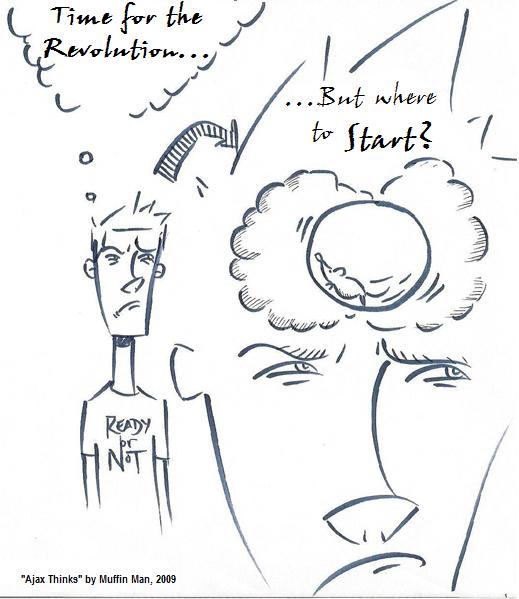
Ajax Thinks

Ajax Thinks
by Muffin Man

Saturday, May 12, 2012

I want peas...World peas

          Homer Simpson once joined the Navy reserve. In comical fashion he found himself having dinner with the Commander of the submarine he was serving on. The Commander asked Homer what he wanted more than anything else. Homer, with a bowl of peas, just out of reach, responded "Peas." The Commander, hearing "peace" was thrilled, and asked how Homer expected to get it, to which he responded "with a knife!" He then used a knife to retrieve some peas from the bowl. The gag continues, but that should be sufficient for explaining the title of this post. Now on to explaining the body of the post.

          What follows is my response to a discussion question in my online Social and Cultural Psychology class. This week is the final and then another class is finished along my Master's pathway. The question was regarding optimistic and pessimistic views of the possibility of global unity. Here is my response copied directly over from the discussion board wall:

         I really wish I would have kept one of my books from a sociology class a few years ago. The book was by John Turner and in it he mapped out his theory of racial discrimination. He had a flow chart in the book that showed how discrimination lead to identifiability, which eventually lead to increased discrimination. I’ve always found this to be fascinating because to me it means that the more we focus on the differences and how they need to be accepted, we inadvertently increased the separation. You can’t glue a broken vase back together by focusing on how broken the pieces are, you have to get some glue and put the pieces back together. Typically you’ll need some sort of brace as well to hold it in place as the glue dries.

         Now with global unity we can look at it in the model of a broken vase. It is an easy comparison to visualize with the jagged property lines between states and countries across the globe. We are all people, but we don’t focus on that; we don’t focus on the glued together vase, we simply keep to our own broken piece of porcelain and focus on how broken the rest of the vase is in comparison to our little intact piece. Many countries want to get the vase back together, but not for the sake of getting the vase back together, but rather in order to increase the size of their piece.

         Lately I’m finding myself to be very pessimistic although I feel that I am a generally hopeful person. I don’t believe I am a “downer” to other people. People seem to be generally entertained by me, so I don’t consider myself a pessimist or depressing person. But my point of view regarding global unity would probably be classified as pessimistic. I believe that since we are all humans, we share a really strong bond of commonality. Global unity takes more than a familial tie, however. Global unity is going to require a great deal of compromise. As we have just discussed the differences and similarities between cultures based on Hofstede’s values, we see that there are some dramatic differences in cultural motivations and practices.

         A culture that believes in a central government that governs the masses is going to have a tough time melding with a culture that believes that the family governs itself and neighbors simply coexist in peace, because they do, without government intervention. Likewise, cultures where women are beneath men, and baby girls are sacrificed to vain pride of the parents, will clash with cultures where human life is respected and all children, all genders are celebrated just because they are of our human family (although it seems like these types of countries are fewer and fewer these days). These types of differences in culture and other differences that are more extreme can’t coexist in peace. One or the other has to give if the two are going to coexist. The question then becomes which aspect of each culture has to yield and which aspect gets to thrive?

         Why is global unity difficult to imagine? Because there is too much selfish pride in the world. Until this is eradicated cultures will remain broken pieces of a vase. Focusing on the broken pieces of the vase will never get it back together. Some of the unique aspects of those broken pieces will need to be lost in order to reunite into one vase again. Assimilation is necessary to form one united culture. I don’t expect to see this happen without a very influential uniting factor, such as war, disease, famine, or love. I think it would be great for the world to unite in love, but I don’t think it will happen without some huge shifts in current trends. Until we have a global uniting factor, a common belief, I don’t see it happening. We already share the same blood, which is a pretty intimate connection, but that hasn’t been enough for the world to see past skin color and eye shape. As unpopular and divisive sounding as my opinion is, I don’t believe unity will exist until the focus on differences is abandoned and the focus on similarities embraced. Please note I said “the focus on” and not the differences themselves. I am not supporting a culture of clones, but rather a culture of individuals with common goals and ideals. I think if people would forget themselves just a little bit, and reduce their need for competition, they would find that there are some basic beliefs we could all agree on without losing individuality and creativity.

Monday, April 30, 2012

Occupy May Day

          I will not begin to pretend like I know what the Occupy movement is all about. I think they are trying to show that the people, united, are still the controlling power in this country. It's either that or they can't afford to pay their cable bill anymore and they are getting bored at home. Maybe I'm being too generous. I don't know what their motives are, but I know they are asking me to not go to work, to not participate in my grad school class, to not clean my home, to not purchase anything, and to publicly demonstrate against capitalism. Well, I won't be doing any of that stuff for May 1st.

          I will be occupying my desk at work, because I need to get paid. The reason I need to get paid is that I need to occupy the kitchen cupboards with food for my family so that we can occupy our stomachs with sustenance.

          I hate the trend of our country right now, I think the government is out of control and out of touch, and a lot of the people in the country are right there with them. But I don't see how taking leave of our responsibilities to walk around a street with a sign is going to do anything. I guess we'll see tomorrow. If 99% of the country stays home or protests tomorrow and then everything changes on Wednesday, I guess I'll be surprised. My predictions for May 1st is a lot of people with greasy hair being sprayed with pepper spray and then arrested. Prove me wrong, occupiers, prove me wrong!

Monday, April 23, 2012

A quick bit of opinion from the news

I was clicking through the Yahoo! news top stories and came across this:

From: http://news.yahoo.com/why-i-trust-young-voters-more-than-any-politician.html

I read the piece, it's an opinion, at some points I disagree, at other points I do agree. But that's not what caught my eye. The caption that the Yahoo! writers have chosen to lead into this story is:

"The Def Jam co-founder believes this generation has the potential to shape the next 40 years."

All I have to add is, "duh?"

Sunday, April 22, 2012

Look what I can do

I miss writing blog posts, but I've been pretty busy writing school assignments lately. I'd hate to go an entire month without posting anythying, an entire month name-wise, I've probably gone more than 30 days at a stretch by now. So, in the interest of posting something for April, here is one of my recent school assignments, I chose this one because of my concluding paragraph. You can take the boy out of the regular whimsical revolutionary blogging, but you can't take the whimsical revolutionary blogging out of the boy...

Making decisions based on judgment is at the heart of living. As we interact socially with people of various levels of familiarity, we are constantly making judgments of people whether we know it or not. We make our decisions based on appearance, observed behavior, or initial strains of conversation. The culture we are socialized into determines a lot about the judgments we make. Nationality, religion, political agenda, and fashion interests all play into the judgments we make about people. Social psychologists study these judgments and their accuracy in applying the term fundamental attribution error, which is that we are more likely to attribute a person’s behavior to internal causes rather than external causes, interestingly the opposite of how we tend to attribute our own behavior. This paper delves into the cultural influence evident in the fundamental attribution error and applies the theory to recent social psychological research.

When happening upon a scene in public, we often don’t know much about the setting and environment of that moment. When we see someone behaving a certain way in that setting we don’t necessarily know why they are doing what they are doing, or how they perceive the setting they are in. What do we do in this situation? We are going to make a judgment about the person, consciously or not, and we will more than likely attribute the actions of the person to their personality, not their environment (Aronson, Wilson, & Akert, 2010, p. 99). When we see a young woman by the fountain downtown with her arms up like wings, twirling in circles, we will most likely think she is an outgoing and unconventional, if not worse, person. What we are missing is the camera focused on her filming her antics for a school video project. According to Changingminds.org (2012), “this can be due to our focus on the person more than their situation, about which we may know very little. We also know little about how they are interpreting the situation.”

Various cultures reflect the fundamental attribution error in different ways. What makes this process so common is its focus on the person, rather than the situation, a common process among Western cultures. North America, primarily, represents Western cultural thinking, which is to focus on the individual and analytic thinking, while the countries of Eastern Asia focus on the bigger picture, including the environment in which something occurs (Aronson, Wilson, & Akert, 2010, p.104). Because of these differences, the fundamental attribution error is more frequently espoused in Western thinking societies. “Western culture exacerbates this error, as we emphasize individual freedom and autonomy and are socialized to prefer dispositional factors to situational ones” (Changing Minds, 2012). Other cultural factors, such as gender perceptions may play into the judgments we make. A man who is brought up in a misogynistic culture, upon seeing a woman in a traffic accident, will attribute the crash to the fact that she is a woman rather than seek for external influences in the accident, such as icy roads or vehicle malfunction.

An interesting study about attributing social behavior to personal qualities was conducted by Brumbaugh and Rosa in 2009. Looking at coupon use trends among different ethnoracial and socioeconomic groups, the researchers studied the results of embarrassment and cashier influence on the customer’s use of coupons. This study doesn’t involve the fundamental attribution error directly; instead it looks at the perception of the error in the minds of customers. In this case, the fundamental attribution error is made by a cashier, judging coupon use by different racial or economic groups as a reflection of the person, rather than their situation, in turn this judgment is perceived by the customer and leads to embarrassment and influences their use of coupons (Brumbaugh and Rosa, 2009). The researchers found that customer perceptions of judgment did affect coupon usage in statistically significant ways (2009). While the study’s purpose was not to identify or apply the fundamental attribution error to consumerism, the theory is applicable. We can see in this study how the judgments we make about a person without fully comprehending a situation, thereby attributing behavior solely to internal factors, can influence how we will treat that person.

The fundamental attribution error exists and is influenced by cultural and socialization factors. Perhaps judgments of internal attribution based on observed behavior are unfair or inaccurate much of the time, but the alternative is to launch an investigation into any behavior we see and need to make a decision about. It might be unrealistic to expect such endeavors for everyday life. In some cases it might not only be unrealistic, but impractical or even dangerous to try to determine the environmental cause for behavior. If I come across a person wildly waving a sword around in the park, I’m going to assume the worst and steer clear of them. Even if their behavior can be attributed to a situational factor such as defending against a swarm of bees (as impractical as that would be), approaching for further investigation doesn’t seem any safer than making a judgment based on internal attributions to the swordsman.

References

Aronson, E., Wilson, T.D., and Akert, R.M. (2010). Social Psychology (7th ed.). Englewood, Cliffs, NJ: Prentice. ISBN-13: 9780138144784.

Brumbaugh, A.M. & Rosa, J.A. (2009). Perceived discrimination, cashier metaperceptions, embarrassment, and confidence as influencers of coupon use: An ethnoracial- socioeconomic analysis. Journal of Retailing, 85(3), 347-362. Doi:10.1016/j.jretai.2009.04.008. Retrieved March 31, 2012 from ProQuest http://library.gcu.edu:2048/login?url=http://search.proquest.com.library.gcu.edu:2 048/docview/228620801?accountid=7374

Changing Minds. (2012). Fundamental Attribution Error. Retrieved April 3, 2012, from

http://changingminds.org/explanations/theories/fundamental_attribution_error.htm

Tuesday, March 20, 2012

Renewable Energy

I think it is interesting how much work and worry we put into energy, both fossil fuel and renewable. What would you say if I told you that there have already been countless civilizations who have mastered renewable, clean energy? It's true. Civilizations who would be declared archaic in comparison to our civilization today have mastered clean energy. The most ironic part of it all is that as we entered the industrial age we left behind the clean, renewable energy age. All of our advances in technology have made us more dependent on the diminishing (or so they say, but I don't believe it) resources such as oil.

Think about it for a minute, tractors today run on diesel fuel and do the job of oxen and horses from years past, which oxen and horses run on grass, water, and sunlight. There's your renewable bio fuels: grass, water, and sunlight. We are so far off the mark. Sure, medical advances, communication advances, all that, but do we really need it? What is life all about anyway? Couldn't we accomplish the core purposes without the Internet, the Kindle, Facebook, and Dancing with the Stars? We don't even know what the core purposes of life are any more, not as a collective understanding at least. And when you have sub groups that know the core purposes, they want to kill or convert anyone else who has a different concept of the core purposes.

We are spinning our wheels. I just spent three hours doing ridiculous calculations on numbers for my statistics final exam. Before that I spent 8 hours talking to people about computer software issues regarding electronic storage of image and loan application documents. All for a paycheck. All so I can utilize more diminishing sources of energy. I should say consume, rather than utilize. What did I accomplish today? Nothing, when you qualify things. I spent nearly the entire time I've been awake in front of a computer at work and then a computer at home. It was a beautiful Spring day, but I was inside for all of it except to drive the two miles to the office and back. I spent all of 30 minutes (and that's generous) interacting with my wife, and that was to eat breakfast and dinner together. She was sitting a few feet away from me while I was doing my exam, but we weren't spending time together. How can a day be successful if all I've done is generate some ethereal numbers in my electronic balance for my bank account? All I did was consume non-renewable resources.

How about we start a new occupy movement, called occupy common sense? How about we occupy the ground and grow our own food? How about we occupy the Earth and use renewable energy to secure our basic needs and then spend the rest of the time interacting with each other in philosophical and educational pursuits? We don't need universities, textbooks, science labs, or the Internet to be educated. Oh well.